

IPRA™300

Transforming hard-to-recycle plastics into valuable, recyclable products
Each year, millions of tonnes of complex, multi-material plastics are incinerated or sent to landfill due to the absence of suitable recycling streams. These materials include multilayer packaging, composite products, and mixed plastic waste that conventional recycling processes cannot handle.
Developed by Aisa in partnership with the French sustainability pioneer REPLACE, the IPRA™300 offers a breakthrough response: a fully automated industrial recycling line capable of transforming hard-to-recycle plastic waste directly into durable, functional, and 100% recyclable products.
Built in France by Aisa, the IPRA™ 300 enables local, economically viable circular production, significantly reducing CO₂ emissions while creating long‑lasting value from waste.
One-step recycling process, without pre‑treatment
The IPRA™300 converts unprocessed plastic waste directly into finished products, without washing, drying, sorting, regranulation, or component separation.
Up to 75% of plastic types are compatible with the process, including:
- ABL toothpaste tubes
- Surgical masks
- Flower pots
- Champagne foils
- Many other complex, multi‑component plastic wastes
This simplified process reduces operating costs, limits energy consumption, and enables stable, continuous industrial production.
Durable products designed to replace traditional materials
Products manufactured with IPRA™ technology are resistant to weather, impact, and intensive use, making them suitable for demanding applications.
Typical outputs include:
- Vineyard stakes
- Signalling and fencing poles
- Pallets
- Planks for urban furniture and infrastructure
These products can replace wood, concrete, or metal, while remaining 100% recyclable through the same IPRA™ process, enabling a true closed‑loop system
Proven environmental and economic performance
The IPRA™ solution has been optimised at every stage and validated through an independent Life Cycle Assessment (LCA).
- CO₂ emissions up to 30 times lower than incineration
- Energy consumption approximately 50% lower than conventional mechanical recycling processes
- Economically viable with high output and low operating costs
A single IPRA™300 can produce over 3 million vineyard stakes per year using 100% recycled material, avoiding up to 3,000 tonnes of CO₂ annually compared to incineration
Line configuration
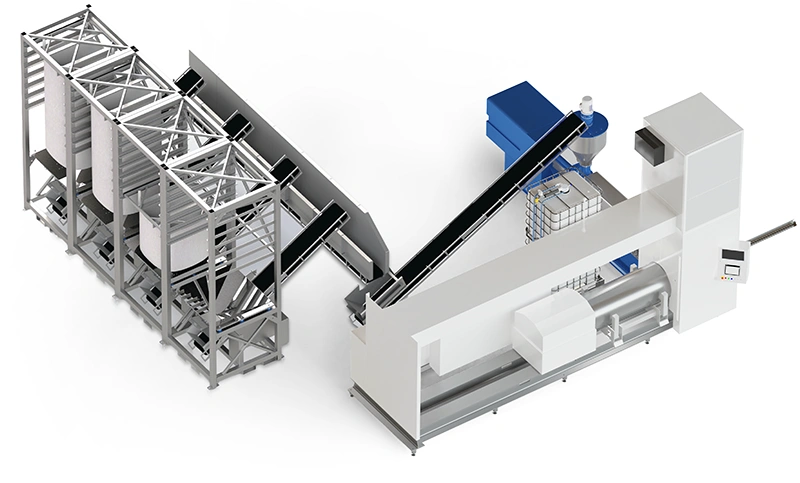
The complete line includes:
- Material feeding system with weighing conveyor
- Two-stage injection line composed of an extruder, a material filter and an injection machine
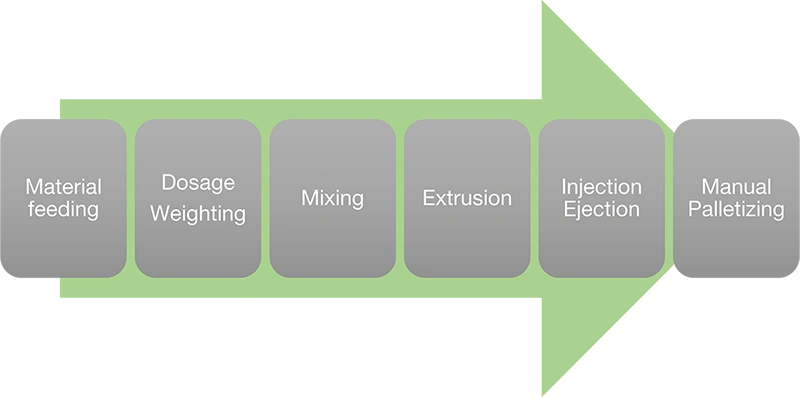
Process overview
Key benefits
A real solution for complex plastic waste
- Recycles plastics with no existing recycling streams
- Converts waste into long lasting, infinitely recyclable products
Low carbon, measurable impact
- 30× lower CO₂ emissions than incineration, confirmed by LCA
- Clear, measurable results for ESG and CSR reporting
Economically viable industrial production
- High throughput with low operational costs
- Suitable for both large scale output and diversified local production
Flexible, localised manufacturing
- Adaptable to agriculture, construction, logistics, urban and public spaces
- Produces standardised or custom products depending on needs
Accessible, robust and easy to operate
- Fully automated, continuous injection process
- Requires only one operator with intuitive interface enabling operation by non-specialist and minimal training
- Designed for easy cleaning and limiting dust generation
- Quick changeover for product length adjustment, minimising line stops and maximising productivity
- Compact footprint for easy installation, even in space constrained facilities

Machine specifications
MACHINE CAPABILITIES
Nominal throughput: 300 kg per hour
(based on a reference mix density of 0.3 kg/L. – approx. 2000 tonnes per year)
RAW MATERIALS
Ground mix of PE / PP / Aluminium / Fibreglass / EVOH
Compatible with inks and varnish residues
FINISHED PRODUCTS
Stakes
Pallets
Urban furniture
Many more!
VALUE-ADDING OPTIONS
Smoke extraction
Camera monitoring system